Sayyed Mu›ðafã Khomeini is among the Muslim jurists who address the establishment of the Guardianship of the Muslim Jurist (Vilãyat-e Faqih) from a relatively novel perspective. He puts emphasis on the advisory (irshãdi) nature of referring to textual (verbal) proofs in favor of rational proofs and stresses the rational necessity of forming an Islamic government and meeting social needs. He also believes in the practical consensus of the Shi‘þ (Twelvers’) jurists on this matter, which indicates that this issue is not an invention of contemporary Muslim jurists but is rooted in the Shi‘þ jurisprudence tradition. Thus, he provides a completely rational foundation for the theory of the Guardianship of the Muslim Jurist, which is based on the principle of expediency (ma›laƒat) and justice. Drawing upon a descriptive-analytical method and library data collection, the present research first explains the advisory (irshadi ) aspects of the arguments for the Guardianship of the Muslim Jurist from the Qur’ãn and Sunnah. It also addresses the reference of the consensus argument to rational arguments and explores the two principles of expediency and justice from Sayyed Mu›ðafã Khomeini's point of view. Considering the advantages of rational proofs, it reveals the dimensions of basing the principle of Guardianship of the Muslim Jurist on rational proofs.
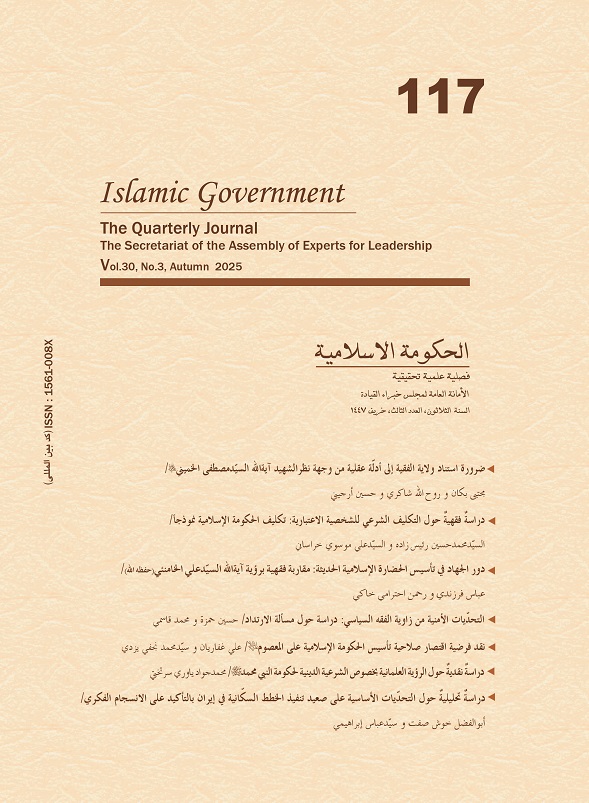
Bagãn, M., shakrei, R. & Arjinþ, U. (2025). The Necessity of Basing the Principle of Guardianship of the Muslim Jurist on Rational Arguments from Sayyed Mu›ðafã Khomeinþ's Perspective. Islamic Government, 30(117), 5–32.
MLA
Bagãn, M., shakrei, R., & Arjinþ, U. "The Necessity of Basing the Principle of Guardianship of the Muslim Jurist on Rational Arguments from Sayyed Mu›ðafã Khomeinþ's Perspective", Islamic Government, 30, 117, 2025, 5–32.
HARVARD
Bagãn, M., shakrei, R., & Arjinþ, U. (2025). 'The Necessity of Basing the Principle of Guardianship of the Muslim Jurist on Rational Arguments from Sayyed Mu›ðafã Khomeinþ's Perspective', Islamic Government, 30(117), pp. 5–32.
CHICAGO
Bagãn, M., shakrei, R. & Arjinþ, U., "The Necessity of Basing the Principle of Guardianship of the Muslim Jurist on Rational Arguments from Sayyed Mu›ðafã Khomeinþ's Perspective." Islamic Government, 30 117 (2025): 5–32,
VANCOUVER
Bagãn M., shakrei R., Arjinþ U. The Necessity of Basing the Principle of Guardianship of the Muslim Jurist on Rational Arguments from Sayyed Mu›ðafã Khomeinþ's Perspective. Islamic Government. 2025;30(117):5–32 (In Persian).